
Subscribe to us:
Follow us on Twitter! Like us on Facebook! Connect on LinkedIn!

Search articles

Got your own blog?
Email us your blog URL and we'll link to our favourite posts!

Educational Partners


Using iPad applications for Alternative and Augmentative Communication (AAC)

By Rebecca Bright on 03 August 2011, 09:00am | Special Educational Needs

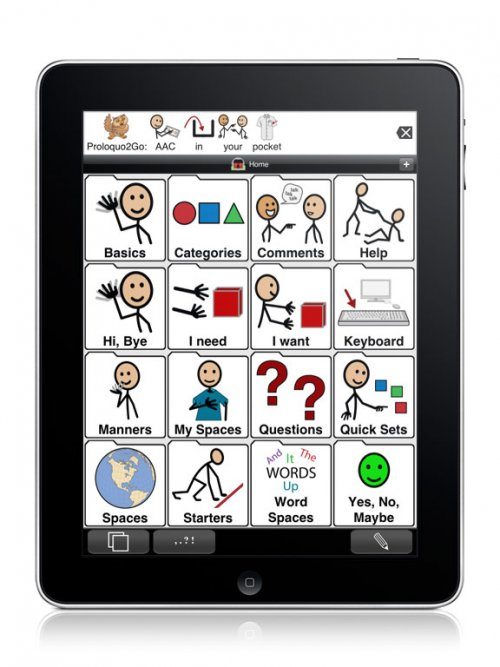
It's no doubt that smart phones and mobile devices have changed the way we work, rest and play. For millions of users, the i-revolution has changed the way we read our news, connect with friends and manage our banking. And now, it’s changed the way we deliver augmentative and alternative communication (AAC) . With a growing number of AAC applications (knows as ‘apps’) available via iTunes, not only does it mean a lighter load for therapists and AAC users (with the 9.7 inch touch screen iPad weighing a mere 1.5 pound), it delivers socially acceptable devices and the ultimate cool factor for clients.

Since the launch of the iPad in 2010, there has been much hype amongst speech and language therapists, families and clients alike with the possibilities for the iPad as an AAC device. The iPad and its apps offer an affordable and socially inclusive alternative to traditional designated devices which are often expensive. The accessibility benefits of the iPad begin with the built in feature of Voice Over which allows users to be given auditory information about what is on screen as it voices text on touch.

It is essential for therapists and teachers to keep up to date with the apps that are available to ensure that they are trialling and recommending the most appropriate apps for their client. The recent article by Jessica Gosnell outlined how feature matching should be used to help guide decision making when choosing an appropriate communication aids for clients.

An iPad can be both a great AAC device for your client and an essential tool for your therapy kit. With new apps coming out each day, there’s always something new to try out. Useful websites and blogs which discuss the latest apps are:

REFERENCES

Gosnell, Costello and Shane (2011) There Isn’t Always An App For That. Perspectives on Augmentative and Alternative Communication.

Sennott and Bowker (2009) Autism, AAC, and Proloquo2Go. Perspectives on Augmentative and Alternative Communication.

Learn more...

Check out Innovate My School's Mobile Phone Apps Directory for a comparison of some of the latest education apps on the market.

Read 4019 times
Topics:
Rebecca Bright

Rebecca Bright

Rebecca is an experienced speech and language therapist who works with adult clients with neurological communication impairments. Rebecca became interested in finding a more mainstream “cool” AAC device. As an off-shoot to her successful therapy resource website Therapy Box, Rebecca has formed www.tboxapps.com and with the feedback from fellow clinicians and AAC users has developed two applications for the iPad/iPhone, ‘Predictable’ and ‘Scene & Heard’, available from iTunes.

Website: www.tboxapps.com/ Email: This e-mail address is being protected from spambots. You need JavaScript enabled to view it

Stay up to date!

Leave a comment


Ads by Google
Give Feedback!