

Peter Worley is the CEO and co-founder of registered charity The Philosophy Foundation, president of SOPHIA and a Visiting Research Associate at King’s College London. He has been working in classrooms doing philosophy since 2002, and is an award-winning author of many books on the subject including The If Machine, and his latest, 40 Lessons to Get Children Thinking, both from Bloomsbury.
This approach to teaching critical thinking (CT) makes use of the ‘descriptive-not-prescriptive’ principle I introduced in this article for Innovate My School. In other words: teach by showing them (the students) what they already do rather than telling them what they should be doing but aren’t. Though I will talk about philosophy sessions, as that is my background, the principles and procedure that you will find outlined here apply to any teaching context where the teaching of CT skills will be of value, whether maths, English or P.E.

Here’s a short lesson in critical thinking to help improve your attitude to your students being wrong. A young child in your class says: “It flies because it’s a bird, obviously!” Question: is the child right or wrong?

One of the most common questions put to me when I do training on facilitating dialogues with teachers, especially when they’re secondary school teachers, is: “All this dialogue stuff is great, but how can we transfer all this on to the page?”, or words to that effect. I think the answer lies in the question itself: to transfer the fruits of dialoguing onto the page. But how?
If you are unfamiliar with the ‘9 dot problem’ (or have forgotten it) then, before reading this article, I would urge you to attempt the puzzle first:
The 9 dot puzzle:
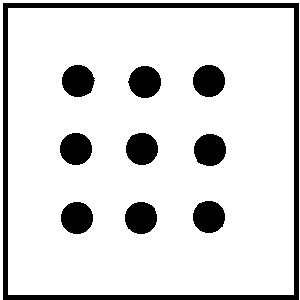
Task: cover all 9 dots with four (or less), straight, continuous lines without tracing over the lines. Do not read on until you have had a go. The solution is at the end of the article.
Year 6 child: ‘Miss, do you think God is real?’
Year 4 child: ‘Miss, what is the answer?’
Among the many useful pedagogical skills we can learn from the Ancient Greek philosopher Socrates, one of the most interesting is that of Socratic irony.
The Chambers dictionary says that Socratic irony is "a means by which a questioner pretends to know less than a respondent, when actually he knows more."
[Source: Wikipedia]
Zoe Williams, of the Guardian, says that "The technique [of Socratic irony], demonstrated in the Platonic dialogues, was to pretend ignorance and, more sneakily, to feign credence in your opponent's power of thought, in order to tie him in knots."









1,300+ guest writers.
2,500+ ideas & stories.
Share yours.

A community-driven platform for showcasing the latest innovations and voices in schools
Pioneer House
North Road
Ellesmere Port
CH65 1AD
United Kingdom